
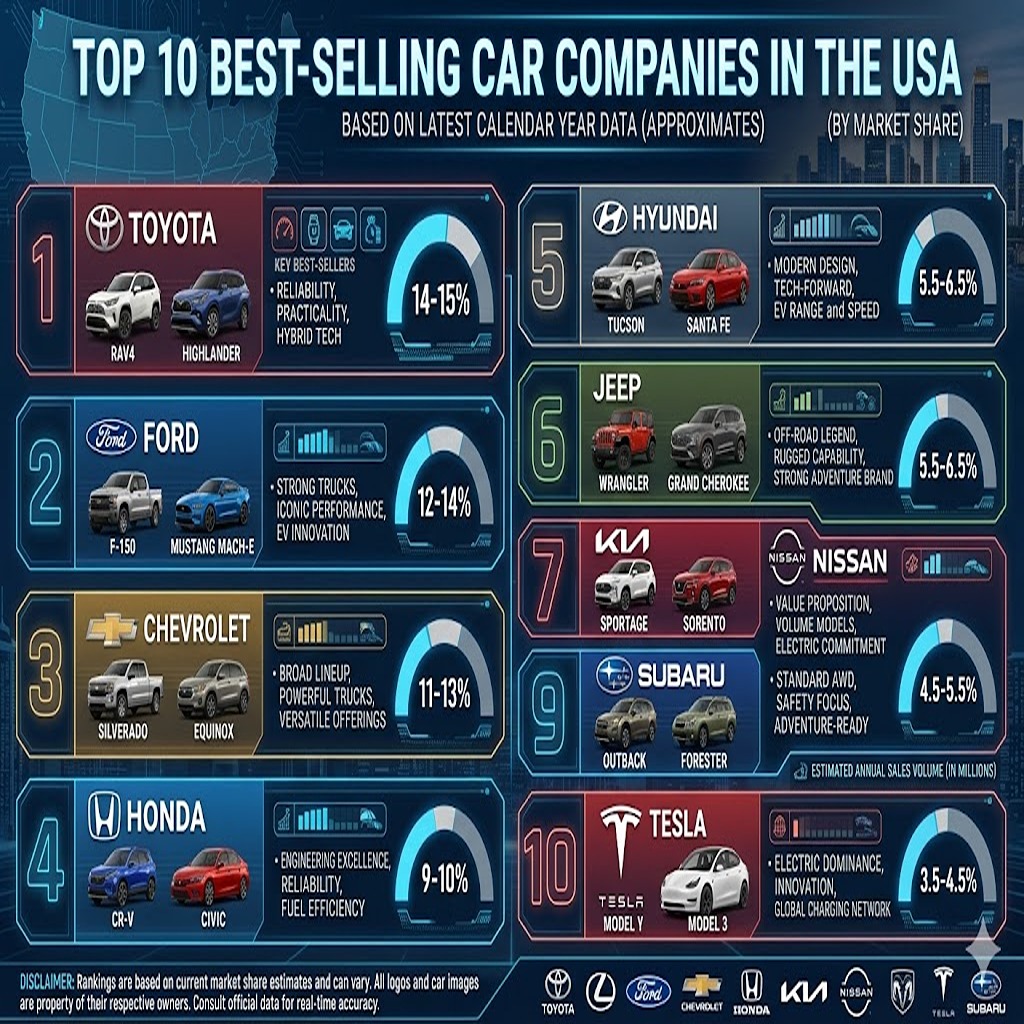
The American automotive landscape is a dynamic, high-stakes battleground where legacy automakers face off against aggressive newcomers and innovation drivers. Every year, a select group of companies dominates, capturing the lion’s share of sales across the country. In this post, we’ll dive into the top 10 best-selling car manufacturers in the USA, examining the models and strategies that keep them in the lead.
This list is based on the latest available market data (approximates), reflecting the early trends of 2026. Keep in mind that specific numbers fluctuate monthly, but these ten players consistently hold their ground.
1. Toyota (approx. 14-15% Market Share)
A true powerhouse, Toyota maintains its crown through a dedication to quality, reliability, and unparalleled brand loyalty. While other brands might dominate specific high-volume models (like trucks), Toyota captures the top spot by having a remarkably balanced portfolio of strong contenders in nearly every segment.
- Key Best-Sellers: RAV4, Highlander, Camry, Tacoma.
- The Secret to Success: Toyota has perfected the art of the hybrid. Models like the RAV4 Hybrid and Highlander Hybrid offer impressive fuel efficiency without compromising versatility, appealing to the eco-conscious family driver. Their recent push with electric vehicles, like the bZ4X, and their iconic Tacoma mid-size truck ensures they have something for everyone. “Reliability, Practicality, and Hybrid Tech” are the pillars of their American domination.
2. Ford (approx. 12-14% Market Share)
A quintessential American icon, Ford secures second place largely on the strength of its legendary trucks, combined with a bold and early commitment to electrification.
- Key Best-Sellers: F-Series (F-150), Explorer, Mustang Mach-E.
- The Secret to Success: The F-150 isn’t just a best-selling truck; it is often the best-selling vehicle in America, period. Ford has maintained this dominance for decades while also successfully pivoting to the future. The Mustang Mach-E is a genuine hit in the premium EV market, proving that Ford can blend performance, style, and range. “Strong Trucks, Iconic Performance, EV Innovation” describes their compelling formula.
3. Chevrolet (approx. 11-13% Market Share)
Chevrolet, General Motors’ flagship brand, leverages massive scale, diverse offerings, and deep American roots to claim the third spot.
- Key Best-Sellers: Silverado 1500, Equinox, Malibu (EV options available).
- The Secret to Success: Chevy is all about accessibility and breadth. The Silverado is a fierce rival to the F-150, and the Equinox is a staple in the crucial compact SUV segment. They also have an ambitious EV lineup, including the Blazer EV and Equinox EV, designed to bring electric power to the mainstream market. “Broad Lineup, Powerful Trucks, Versatile Offerings” define the Chevy appeal.
4. Honda (approx. 9-10% Market Share)
Known for reliability and impressive engineering, Honda consistently performs well by focusing on core, best-in-class vehicles.
- Key Best-Sellers: CR-V, Civic, Accord.
- The Secret to Success: Honda doesn’t try to compete in every niche. Instead, it dominates the segments it enters. The CR-V is a perpetual favorite for its practicality and fuel economy (especially the hybrid), while the Civic and Accord continue to define their respective sedan segments, known for longevity and strong resale value. “Engineering Excellence, Reliability, Fuel Efficiency” are Honda’s defining traits.
5. Hyundai (approx. 5.5-6.5% Market Share)
Hyundai has seen explosive growth in the US, morphing from a value-driven brand into a leader in design and technology.
- Key Best-Sellers: Tucson, Santa Fe, Ioniq 5.
- The Secret to Success: Hyundai’s aggressive growth comes from two fronts: bold, distinct designs across their entire SUV lineup (like the striking Tucson) and a stellar, highly acclaimed EV portfolio. The Ioniq 5 and Ioniq 6 have collected numerous global awards, demonstrating their technology and range leadership. “Modern Design, Tech-Forward, EV Range and Speed” are the keys to their upward trajectory.
6. Jeep (approx. 5.5-6.5% Market Share)
Jeep, under the Stellantis umbrella, is unique on this list. It is the only brand dedicated almost entirely to SUVs and off-road capability.
- Key Best-Sellers: Wrangler, Grand Cherokee, Gladiator.
- The Secret to Success: Jeep sells a lifestyle, not just transportation. The Grand Cherokee remains a benchmark for combining capability and comfort, while the Wrangler and its pickup variant, the Gladiator, are icons of open-air freedom and off-road prowess. “Off-Road Legend, Rugged Capability, Strong Adventure Brand” is their undeniable formula.
7. Kia (approx. 5.5-6.5% Market Share)
Similar to its corporate sibling Hyundai, Kia has transformed its image through design, features, and value.
- Key Best-Sellers: Sportage, Sorento, Telluride (highly awarded EV9 is growing fast).
- The Secret to Success: Kia often leads with value, packing its cars with more standard features than competitors, and backs them with an industry-leading warranty. Their models have won multiple ‘Vehicle of the Year’ awards (like the Telluride and EV9), proving they deliver on both substance and style. “Feature-Packed, Stylish, Long Warranty” defines their impressive ascent.
8. Nissan (approx. 4.5-5.5% Market Share)
Nissan is a brand in transition, focusing on refreshing its core lineup and expanding its electric presence.
- Key Best-Sellers: Rogue, Altima, Frontier (with the electric Ariya).
- The Secret to Success: Nissan maintains a strong foothold through volume. The Rogue is a consistent top-seller in the compact SUV market, and the Altima is a key midsize sedan. The Frontier is a strong contender in the midsize truck segment, and the Ariya EV marks their commitment to the electric future. “Value Proposition, Volume Models, Electric Commitment” summarizes their strategy.
9. Subaru (approx. 4-5% Market Share)
Subaru has one of the most dedicated and loyal customer bases in the country, defined by specific requirements.
- Key Best-Sellers: Outback, Forester, Crosstrek.
- The Secret to Success: Subaru is almost perfectly tailored to the needs of specific regions and lifestyles (especially in the Pacific Northwest and New England). Nearly every model comes standard with its Symmetrical All-Wheel Drive, appealing to those seeking safety and adventure. They also prioritize practicality and a reputation for longevity. “Standard AWD, Safety Focus, Adventure-Ready” is why Subaru owners are so passionate.
10. Tesla (approx. 3.5-4.5% Market Share)
The first EV-only manufacturer to break into the top 10, Tesla’s presence here is monumental and continues to redefine the market.
- Key Best-Sellers: Model Y, Model 3.
- The Secret to Success: Tesla single-handedly mainstreamed EVs. The Model Y, despite a high initial price, is often one of the best-selling passenger cars in America. Their brand appeal, massive Supercharger network, and cutting-edge software updates keep them as the undisputed EV market share leader. “Electric Dominance, Innovation, Global Charging Network” are their unique strengths.
Key Market Trends in 2026
- The EV Shift is Real: Looking at this list, you see multiple leaders who are aggressively shifting their portfolio. Ford’s F-150 Lightning and Mustang Mach-E, the rise of Chevy’s EV truck and SUV lineup, and the entire portfolios of Tesla, Hyundai, and Kia all show where the market is headed.
- The SUV King: Every company on this list (except Tesla, though they dominate the segment) relies heavily on SUVs for their high-volume sales. Jeep and Subaru are built almost entirely on them. The consumer demand for versatility and higher ride height remains unstoppable.
- New Players: The entry of Tesla and the dynamic growth of Hyundai/Kia show that the established “Big Three” can no longer take their dominance for granted.
Which of these manufacturers do you think has the best-balanced approach for the future of transportation? Share your thoughts and tell us which model you are most excited about!
Disclaimer: Rankings and market shares are approximate estimates based on early 2026 data. Sales figures fluctuate monthly. This list represents industry-wide sales trends. Consult official data for real-time accuracy.
This post is for informational purposes only and does not constitute financial or investment advice.