
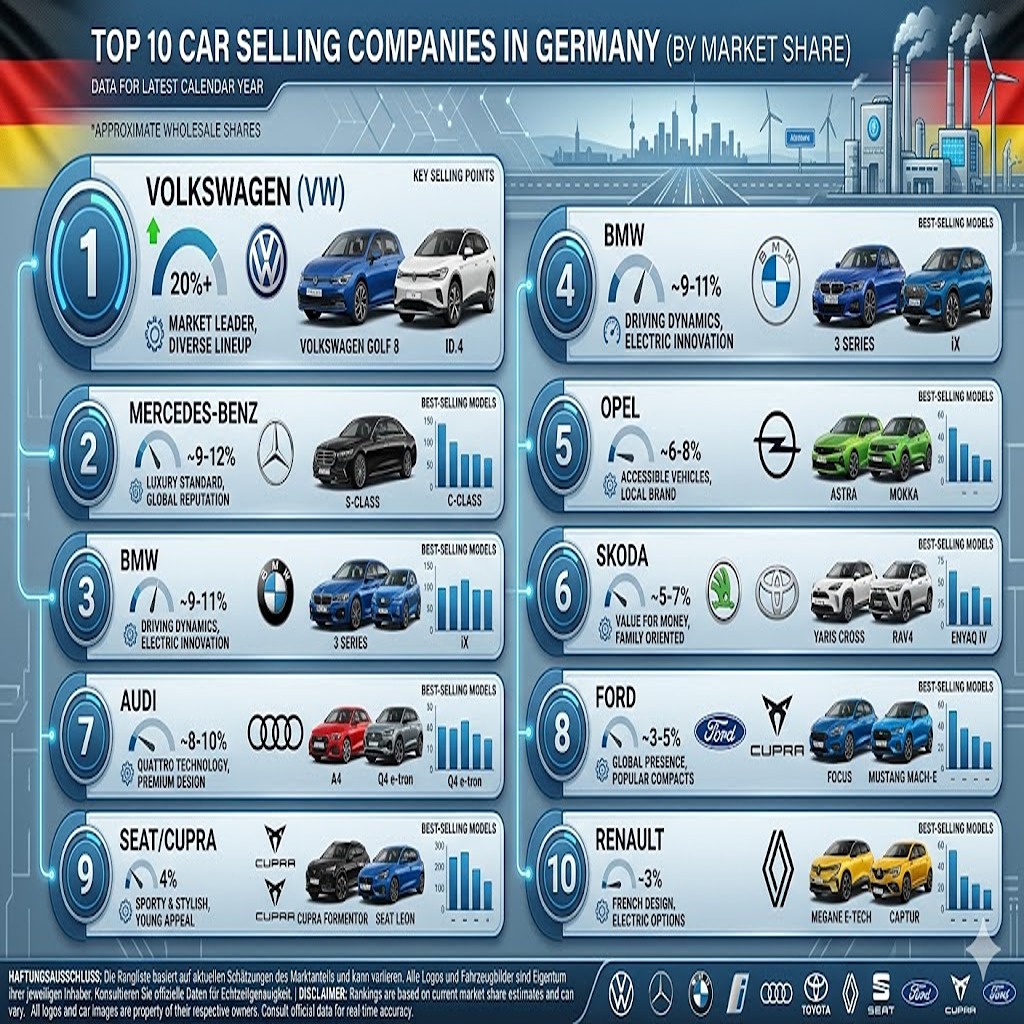
The German automotive market is a complex and highly competitive arena, a blend of world-renowned domestic titans and formidable global players. For many years, a select group has dominated the sales charts, with rankings subtly shifting based on changing consumer preferences, technological advancements, and economic factors. Based on the latest available market share data (approximate and subject to fluctuations), here are the top 10 car selling companies in Germany.
1. Volkswagen (VW): The Undisputed King of the Autobahn
With a commanding market share of over 20%, Volkswagen remains the unchallenged leader. VW’s success is built on its extensive and diverse lineup, offering something for every type of driver and budget. From the iconic Golf, which has been a staple of German roads for decades, to the versatile Passat and Tiguan, and its rapidly expanding ID. series of electric vehicles, VW continues to capture a significant portion of the market. Its ability to offer a comprehensive range of traditional internal combustion engine (ICE) vehicles alongside modern EVs solidifies its dominant position. Key selling points: Market leader, diverse lineup, strong brand loyalty.
2. Mercedes-Benz: A Tradition of Luxury and Innovation
Holding a market share in the range of ~9-12%, Mercedes-Benz stands as a symbol of automotive luxury and advanced engineering. Its reputation is built on decades of producing high-quality, feature-rich, and globally respected vehicles. From the flagship S-Class sedan to the highly popular C-Class and a wide array of SUVs, Mercedes-Benz continues to set the standard for premium automobiles. The brand’s commitment to innovation is evident in its cutting-edge driver assistance systems and its progressive lineup of electric vehicles. Key selling points: Luxury standard, global reputation, advanced technology.
3. BMW: The Ultimate Driving Machine
Hot on the heels of Mercedes-Benz with a market share of ~9-11% is BMW, a brand synonymous with driving dynamics and sporty performance. BMW has long captured the hearts of drivers who value a precise and engaging driving experience. Its core models, like the 3 Series and 5 Series, continue to be popular choices, while its range of SUVs (X1, X3, X5) has significantly expanded its market reach. Like its German counterparts, BMW is investing heavily in electric mobility, with models like the iX and i4 gaining traction. Key selling points: Driving dynamics, electric innovation, strong brand image.
4. Audi: The Sophistication of Quattro and Premium Design
With a market share between ~8-10%, Audi completes the trio of German luxury heavyweights. Audi’s success is built on a foundation of premium design, advanced technology, and its renowned Quattro all-wheel-drive system. The brand offers a sophisticated and stylish alternative, with popular models including the A4 and A6 sedans, the Q3 and Q5 SUVs, and the innovative e-tron series of electric vehicles. Audi’s focus on clean lines and a modern, feature-rich interior resonates well with German consumers. Key selling points: Quattro technology, premium design, sophisticated image.
5. Opel: A Reliable Staple of German Roads
Holding a market share of ~6-8%, Opel is a historic German brand that remains a popular and reliable choice for many drivers. Opel has long focused on providing sensible and accessible vehicles, making it a favorite for families and budget-conscious buyers. Models like the Astra and Corsa have been mainstays of German roads for years, and the brand continues to offer competitive and well-rounded vehicles. Opel’s focus on practical features and a solid value proposition maintains its position in the top five. Key selling points: Accessible vehicles, local brand, value for money.
6. Skoda: Unbeatable Value for Money for Families
A brand that has seen significant growth, Skoda holds a market share of ~5-7%. Skoda’s success is built on an incredible value proposition, offering spacious, practical, and well-equipped vehicles at a competitive price. Models like the Octavia and Superb have become popular family choices, known for their generous cargo space and sensible features. Skoda’s ability to deliver high quality and practicality at a reasonable cost has resonated strongly with German consumers. Key selling points: Value for money, family-oriented, spacious designs.
7. Toyota: The Global Leader with a Strong German Presence
As the highest-ranking non-German brand with a market share of ~4-6%, Toyota’s presence in Germany is a testament to its global dominance and local appeal. Toyota is renowned for its reliability and its pioneering leadership in hybrid technology. Models like the Yaris and RAV4 are popular choices, and the brand’s extensive range of hybrid vehicles provides a compelling option for environmentally conscious drivers. Toyota’s reputation for dependable and efficient vehicles maintains its position as a key player in the German market. Key selling points: Hybrid leadership, reliability, global strength.
8. Ford: Compelling Options in Key Segments
With a market share between ~3-5%, Ford continues to be a significant player in Germany. Ford offers a range of competitive vehicles, particularly in the compact and subcompact segments. The Focus and Fiesta have long been popular choices, and the brand has also introduced innovative electric vehicles like the Mustang Mach-E. Ford’s global presence and its focus on practical and well-rounded vehicles maintain its position in the top ten. Key selling points: Global presence, popular compacts, electric innovation.
9. Seat/Cupra: Sporty Appeal and Young Designs
The combined brands of Seat and Cupra hold a market share of ~4%, capturing a distinct and growing segment of the German market. Seat offers a range of stylish and practical vehicles, while Cupra provides a performance-oriented and sporty alternative. Models like the Leon and Formentor have gained significant popularity, particularly among younger drivers who value design and dynamic performance. This combined entity has successfully carved out a niche within the competitive market. Key selling points: Sporty & stylish, young appeal, dynamic designs.
10. Renault: French Innovation and Electric Leadership
Rounding out the top ten with a market share of ~3%, Renault remains a key player with a focus on practical and innovative vehicles. Renault has been a pioneer in electric mobility, and its ZOE was one of the first widely accessible EVs on the market. The brand continues to offer competitive electric and hybrid vehicles, alongside its traditional ICE models. Renault’s focus on French design and accessible innovation maintains its presence in the German market. Key selling points: French design, electric options, practical vehicles.
Disclaimer: This ranking is based on current market share estimates and can vary significantly month to month and year to year. All logos and car images are the property of their respective owners. Consult official industry data, such as reports from the Kraftfahrt-Bundesamt (KBA), for real-time accuracy.